
The History of ERCOT
How Texas Built an Electrical Empire—and Nearly Lost It All
Key Takeaways
- 01 Texas deliberately isolated its power grid starting in the 1930s specifically to avoid federal regulation—a calculated act of defiance that created America’s only major independent electrical system.
- 02 ERCOT manages the only major U.S. grid that operates almost entirely outside federal jurisdiction, serving 26 million customers across 90% of the state’s electrical load.
- 03 The 1999 deregulation experiment created a free-market energy system that drove innovation, made Texas a wind power leader, and lowered prices—while hiding a catastrophic vulnerability.
- 04 Winter Storm Uri killed at least 246 Texans and caused an estimated $195 billion in damage—the largest energy infrastructure failure in American history.
- 05 The fundamental question remains unanswered: Is Texas’s fierce commitment to electrical independence worth the price? The state has answered with reforms, not reconnection.
The control room at ERCOT headquarters in Austin is quiet in a way that makes the operators’ skin crawl. Outside, Texas is freezing. Inside, the numbers on the screens are doing something no one in this room has ever seen before.
Grid frequency is dropping. It sits at 59.4 Hz and falling—a number that means nothing to most Texans but everything to the engineers staring at it. Normal operating frequency is 60 Hz. At 59.4 Hz, automatic systems begin disconnecting generating units to protect themselves. At 59.3 Hz, cascading failures become inevitable. At some point below that, the grid dies entirely.
Senior operators start making calls. Ruthless calls. Neighborhoods are about to go dark—not for minutes, but for days. There is no alternative. The choice is controlled devastation or total collapse.
The math is simple and brutal: cut load now or lose everything. Four million five hundred thousand Texans are already without power. The ones still connected are about to join them. Outside, the temperature is dropping into the single digits. Pipes are freezing. People are burning furniture to stay warm.
At 1:23 AM on February 15, 2021, the Texas electrical grid—a system serving 26 million people, representing the ninth-largest economy on Earth if Texas were its own nation—is four minutes and thirty-seven seconds from complete collapse.
Four minutes and thirty-seven seconds from a scenario that would take months to recover from. A cold restart of an entire electrical grid—something never attempted at this scale in American history. Hospitals on emergency generators that would run dry. Water treatment plants offline. Communications down. The supply chains that feed 30 million people, severed.
The operators don’t flinch. They can’t afford to. They order the load shedding that will keep the grid alive. Transformers across the state receive commands to open their breakers. The lights go out in a geometric pattern across the frozen darkness.
The frequency stabilizes. Texas stays online—barely. But 4.5 million people will remain without power for days. At least 246 will die. Property damage will exceed $195 billion. It will be, by every measure, the largest energy infrastructure failure in American history.
• • •
To understand how 30 million Texans found themselves this vulnerable—how the state that pumps more oil and gas than most countries ended up four minutes from losing its entire electrical grid—you have to go back to 1935. You have to understand a decision that was equal parts defiance, ingenuity, and hubris. You have to understand why Texas stands alone.
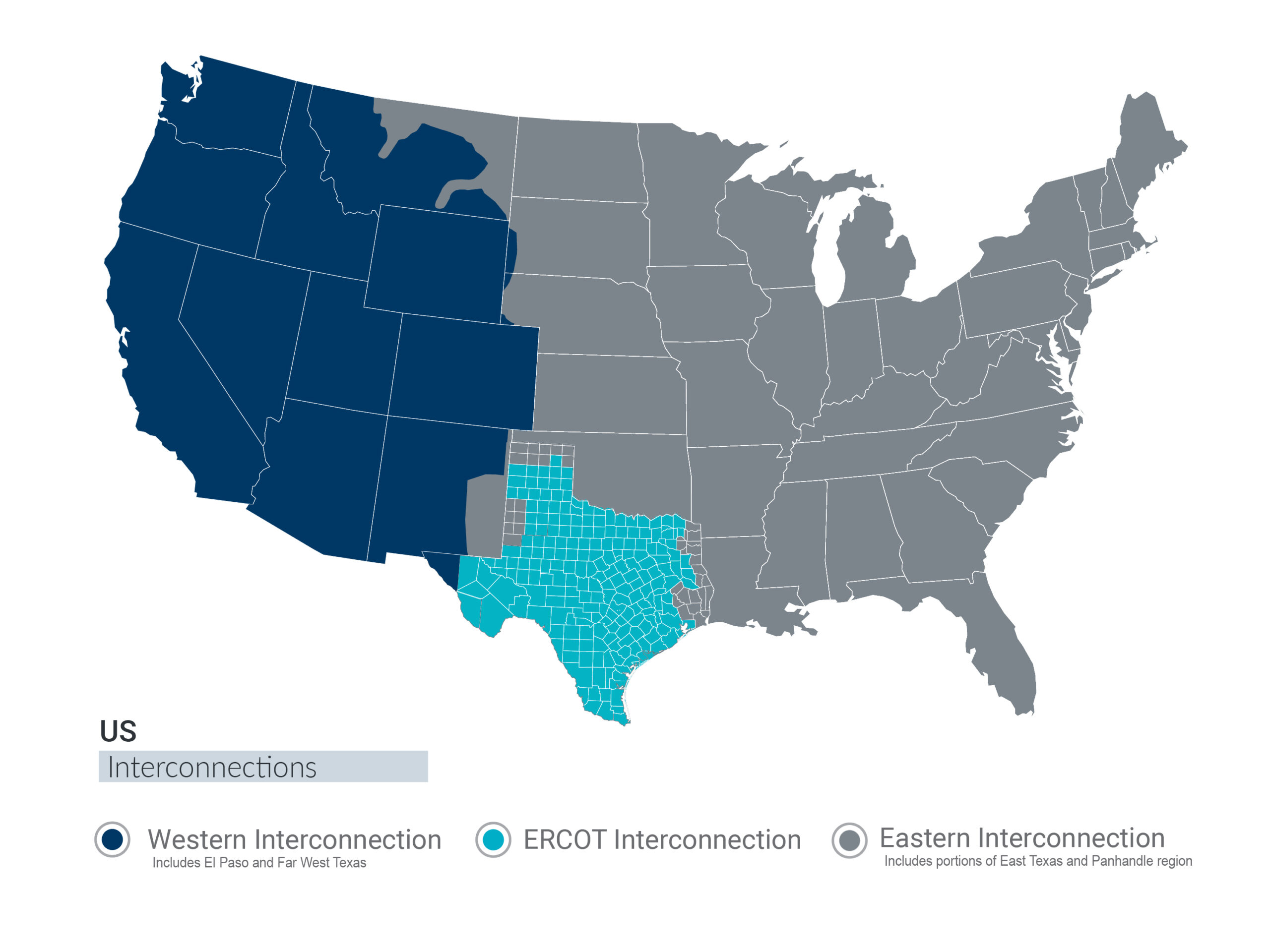
America’s Three Power Grids
Texas is the only state with a grid substantially independent of federal oversight
Eastern Interconnection
220M+ people servedCovers states east of the Rockies, excluding Texas. Federally regulated under FERC.
Western Interconnection
80M+ people servedCovers states west of the Rockies plus parts of Canada and Mexico. Federally regulated.
ERCOT (Texas)
26M customers served90% of Texas load. 680+ generators. Outside federal jurisdiction. Standing alone by design.
Building the Island
For three decades, Texas’s electrical island worked remarkably well. ERCOT coordinated the growing network of power plants and transmission lines that kept the lights on from El Paso to Beaumont. The state’s economy boomed. Its population exploded. And most Texans had no idea they lived on an electrical island—or what that meant.
The system’s isolation wasn’t just regulatory. It was physical. The Eastern and Western Interconnections could share power when one region needed help—sending electrons thousands of miles to balance supply and demand. Texas couldn’t. When Texans needed more power, it had to come from Texas. When Texas had too much power, it couldn’t be exported. The grid had to balance itself, within its own borders, second by second.
ERCOT’s engineers became masters of this balancing act. They managed seasonal peaks when air conditioners roared in August. They coordinated planned outages when power plants needed maintenance. They prepared for the occasional cold snap that pushed demand higher than expected. The system hummed along, year after year, proving that Texas could go it alone.
The Philosophy of Independence
The legal battles to maintain Texas’s independence were quieter than the engineering achievements, but just as consequential. Federal regulators periodically questioned whether ERCOT’s limited DC ties to neighboring grids—the small connections that allowed emergency power transfers—constituted interstate commerce. Texas utilities fought these challenges methodically, defending their isolation with armies of lawyers and carefully constructed technical arguments.
The philosophy underlying this defense was pure Texas: markets over mandates, state control over federal oversight, competition over coordination. If the Texas grid worked—and it did work—why invite Washington to meddle?
By the 1990s, this philosophy had evolved into something bolder. Texas wasn’t just defending its isolation anymore. It was preparing to take the experiment further.
• • •
Act III: 1999–2020The Great Experiment
In 1999, the Texas Legislature passed Senate Bill 7. Governor George W. Bush signed it into law with characteristic enthusiasm, promising that competition would lower prices and spur innovation. The bill deregulated the state’s electricity market, breaking apart the old utility monopolies and creating something unprecedented: a wholesale electricity market where generators competed to sell power, and a retail market where consumers could choose their own electricity provider.
It was the most ambitious deregulation of an electricity market ever attempted in the United States. And ERCOT was at the heart of it.
The Free Market Ascendant
The newly deregulated market transformed ERCOT from a coordination body into something more like a stock exchange for electrons. Generators would bid to supply power at certain prices. ERCOT would dispatch the cheapest generation first, then the next cheapest, working up the cost curve until supply matched demand. Prices would fluctuate with supply and demand—sometimes wildly.
The theory was elegant: let the market set prices, and the market would deliver efficiency. High prices would signal the need for new generation, attracting investment. Low prices would reward efficient producers and punish wasteful ones. Competition would drive innovation.
For two decades, much of this theory proved correct. Electricity prices in the ERCOT market fell below the national average. Texas became the national leader in wind power, adding turbines at an astonishing pace across West Texas and the Panhandle. Natural gas plants proliferated, offering flexible generation that could ramp up quickly when the wind died down. The Texas grid grew more diverse, more dynamic, and—by most measures—more efficient than its regulated counterparts.
The Hidden Vulnerability
But deregulation created something else too: a system optimized for profit rather than resilience.
In a regulated market, utilities earn a guaranteed return on their investments. Build a power plant that sits idle most of the year? No problem—ratepayers cover the cost. Winterize your equipment against once-in-a-decade cold snaps? The regulator will approve the expense.
In Texas’s deregulated market, generators only got paid when they produced power. A plant that sat idle earned nothing. Equipment winterization cost money that came straight out of profits. Every dollar spent on resilience was a dollar not returned to shareholders.
The result was a grid that ran lean. Very lean. Plants were built to operate during peak summer demand, when prices were highest. Equipment was winterized only if the cost-benefit analysis justified it. Reserve margins—the cushion of extra generation capacity that provides insurance against unexpected demand—shrank as economics pushed the system toward just-in-time efficiency.
This optimization worked beautifully in normal conditions. It was a disaster waiting to happen in abnormal ones.
The Ignored Warning
February 2011: Rolling blackouts hit Texas. 3.2 million customers lose power. Federal investigators recommend mandatory winterization of generators.
The problem: ERCOT operates outside federal jurisdiction. Recommendations were voluntary. Winterization costs money. Generators chose not to spend it.
The gamble: Texas utilities bet that severe cold was too rare to justify the investment. For ten years, that bet paid off.
The Reckoning
Now you understand what the operators in that control room were facing at 1:23 AM on February 15, 2021. Now you understand the weight of 86 years of history pressing down on those blinking screens.
The grid they were fighting to save wasn’t just a collection of power plants and transmission lines. It was the physical manifestation of Texas’s longest-running bet against the federal government—a wager that independence was worth more than the safety net of interconnection.
Winter Storm Uri arrived on February 13. The weather models had predicted it, but the models couldn’t capture the full brutality of what was coming: a polar vortex that would push Arctic air deep into the heart of Texas, driving temperatures 30 to 40 degrees below normal for days on end.
The Cascade
The failures started in the natural gas fields. Wellheads froze. Pipelines dropped pressure. Processing plants shut down for lack of supply. Natural gas generators—which provided nearly half of ERCOT’s winter capacity—found themselves with no fuel to burn.
Wind turbines iced over. Not all of them—many kept spinning—but enough to matter. Coal plants discovered their fuel piles had frozen solid. Nuclear plants tripped offline when sensors and pipes froze. The diverse generation portfolio that was supposed to provide redundancy failed in synchronized fashion, each source succumbing to the same overwhelming cold.
By the morning of February 15, ERCOT had lost nearly half its generation capacity. But demand was spiking to all-time winter highs. Texans cranked their heaters. Pipes began freezing, then bursting, and water pumping systems demanded more electricity to maintain pressure. The gap between what Texans needed and what the grid could provide widened by the minute.
The Edge of Collapse
Grid frequency dropped. 60 Hz is normal. Below 59.4 Hz, automatic protection systems begin disconnecting generators to save themselves from damage. Below 59.3 Hz, cascading failures become inevitable. The entire grid begins to unravel.
At 1:23 AM on February 15, frequency hit 59.4 Hz. The grid was four minutes and 37 seconds from total collapse.
A complete collapse—what engineers call a “black start” scenario—would have been catastrophic beyond imagination. Restarting an entire grid from zero is a process that takes days under ideal conditions. In subfreezing temperatures, with frozen equipment, fractured fuel supplies, and 30 million desperate customers? It could have taken weeks. Maybe longer.
The operators ordered emergency load shedding. Transformers across the state received commands to disconnect. The lights went out in homes and hospitals, in water treatment plants and grocery stores. It was controlled devastation—the only alternative to uncontrolled catastrophe.
The Long Dark
The grid stabilized. Texas stayed online. But 4.5 million customers had lost power, and for many, it would stay off for days. The rolling blackouts that were supposed to last 15 to 45 minutes stretched into hours, then days. Some neighborhoods didn’t see electricity return for 80 hours or more.
Texans burned furniture to stay warm. They slept in cars with the engines running. They huddled in circles at emergency warming centers. They watched their pipes freeze and burst, flooding their homes with water that quickly turned to ice.
And they died. At least 246 Texans died during Winter Storm Uri, according to the Texas Department of State Health Services. Some froze to death in their homes. Some died from carbon monoxide poisoning when they ran generators or grills indoors. Some died when medical equipment failed. Some died in the aftermath, from exposure, from stress, from a healthcare system overwhelmed by the crisis.
The actual death toll may be much higher. A BuzzFeed News analysis suggested the true count could exceed 700.
The Human Cost of Winter Storm Uri
The largest energy infrastructure failure in American history
More Texans lost power during Winter Storm Uri than the entire population of Louisiana.
The Price of Independence
In the aftermath of Winter Storm Uri, Texas faced a question it had avoided for 86 years: Was independence worth it?
The answer, at least from the state’s political leadership, was unequivocal: the grid would remain independent. There would be reforms, not reconnection. Texas would fix its system, not abandon its principles.
The Reform Push
The Texas Legislature moved quickly. Senate Bill 2 restructured ERCOT’s board, replacing the out-of-state members who had drawn public fury with appointees chosen by state leadership. Senate Bill 3 mandated winterization of power plants, required generators to prepare for extreme weather, and created a new oversight framework to ensure compliance.
The Public Utility Commission of Texas gained new authority to set reliability standards. ERCOT implemented new weatherization inspections. Natural gas facilities—the critical link that had failed so catastrophically—faced new requirements to ensure supply during cold weather events.
Whether these reforms are sufficient remains an open question. The weatherization standards, while more stringent than before, still fall short of what exists in colder states. The reserve margins remain tight. The fundamental market design—which rewards efficiency over resilience—has been tweaked but not transformed.
The Debate Continues
Some engineers and energy experts have called for connecting ERCOT to the national grids. The technology exists. DC ties could allow emergency power imports during crises while maintaining ERCOT’s operational independence for routine purposes. It would be a lifeline, not a surrender.
But in Texas, this remains politically unthinkable. Interconnection would invite federal regulation. It would compromise the independence that Texas has defended for nearly a century. It would be an admission that the state cannot take care of itself.
And so the experiment continues. Texas has placed new bets—on better winterization, on improved oversight, on market mechanisms designed to encourage reserve capacity. The grid operators have better tools and clearer authority than they did in February 2021. The question is whether it will be enough when the next test comes.
The Unresolved Question
Standing alone has always been the Texas way. From the Republic to the Railroad Commission, from the oil fields to the electrical grid, the state has charted its own course with a confidence that borders on defiance. That confidence built something remarkable—an economy larger than most nations, an energy sector that powers the world, an electrical system that, for most of its history, delivered reliable power at competitive prices.
But standing alone means standing alone when things go wrong. It means no lifeline when the cold comes and the generators fail. It means that every crisis must be solved within the borders, with the resources at hand, or not solved at all.
Texas gambled on autonomy. For decades, that gamble paid off handsomely. Then February 2021 came due, and 246 Texans paid the ultimate price.
The bill for independence turned out to be higher than anyone had imagined. The question now is whether Texas has done enough to ensure it never comes due again—or whether the next great freeze will find the state, once more, standing alone in the cold.
The operators in that Austin control room saved the grid that night. They made the brutal calculations, ordered the load shedding, and kept Texas from total collapse. But the system they saved is the same system that brought them to the edge. The fundamental architecture remains: Texas, standing alone, betting that its independence is worth whatever comes next.
Frequently Asked Questions
Why is Texas on its own power grid?
Texas deliberately isolated its power grid starting in the 1930s to avoid federal regulation. When the Federal Power Act of 1935 gave the federal government authority over interstate electricity transmission, Texas utilities ensured their electrons never crossed state lines. This kept the grid under state jurisdiction only. The isolation has been maintained ever since, making ERCOT the only major U.S. grid substantially outside federal oversight.
What is ERCOT and what does it do?
ERCOT (Electric Reliability Council of Texas) is the organization that operates the Texas power grid. Created in 1970, ERCOT coordinates electricity generation and transmission across the state, manages the wholesale electricity market, ensures supply meets demand second-by-second, and maintains grid reliability. It serves 26 million customers and manages 90% of Texas’s electrical load through more than 680 generators.
Why did the Texas power grid fail in 2021?
The Texas grid nearly collapsed during Winter Storm Uri due to inadequate winterization of power generation equipment. Natural gas wells froze, cutting fuel supply to generators. Wind turbines iced over. Coal piles became too frozen to use. Nuclear plants tripped offline. The grid lost nearly half its generation capacity while demand spiked to record highs. ERCOT came within 4 minutes and 37 seconds of total collapse before emergency load shedding stabilized the system.
When was ERCOT created?
ERCOT was formally established in 1970. However, Texas utilities had been informally coordinating their operations and maintaining grid isolation since the 1930s. The 1970 formation of ERCOT institutionalized this coordination, creating an official body to manage the state’s independent electrical system. In 1999, ERCOT’s role expanded significantly when Texas deregulated its electricity market.
Can Texas connect to the national grid?
Technically yes, but it remains politically opposed. Texas has small DC interconnections with other grids that can transfer limited emergency power. Full interconnection would be technologically feasible but would subject ERCOT to federal regulation under FERC—the very outcome Texas has avoided for nearly 90 years. Following Winter Storm Uri, some experts called for interconnection, but Texas leadership has rejected this option, choosing reforms over reconnection.
How many people died during Winter Storm Uri?
At least 246 people died according to the Texas Department of State Health Services. Deaths resulted from hypothermia, carbon monoxide poisoning from improper indoor heating, medical equipment failures, vehicle accidents, and other storm-related causes. However, independent analyses suggest the true death toll may be significantly higher—possibly exceeding 700—due to undercounting of indirect deaths in the weeks following the storm.
Sources & References
Primary sources consulted for this article
Government & Regulatory Documents
- Federal Power Act of 1935 — 16 U.S.C. §§ 791a–828c, establishing federal authority over interstate electricity
- Texas Senate Bill 7 (1999) — 76th Texas Legislature, electric utility restructuring and deregulation
- Texas Senate Bills 2 & 3 (2021) — 87th Texas Legislature, ERCOT reform and weatherization requirements
- FERC/NERC Staff Report (2011) — Report on Outages and Curtailments During the Southwest Cold Weather Event of February 1-5, 2011
ERCOT Official Reports
- ERCOT Fact Sheet — Official grid statistics, customer counts, and generator data
- February 2021 Extreme Cold Weather Event — ERCOT’s preliminary and final reports on Winter Storm Uri
- Grid Operations Timeline — Minute-by-minute frequency and load data from February 14-19, 2021
Investigative Journalism
- Texas Tribune — Extensive investigative series on ERCOT, Winter Storm Uri, and grid reform
- Houston Chronicle — Coverage of grid operations and utility company decisions
- BuzzFeed News — Death toll analysis suggesting undercount of Uri fatalities
Academic & Economic Analysis
- Federal Reserve Bank of Dallas — Economic impact assessment of Winter Storm Uri
- Texas Department of State Health Services — Official mortality statistics from the February 2021 winter storm
- University of Texas at Austin Energy Institute — Research on ERCOT market design and grid reliability