
The Invisible War: Texas Aquifers and the Battle for What Lies Beneath
Beneath the surface of Texas lies a slow-motion conflict over water rights that affects millions of residents, farmers, and businesses. Understanding the Rule of Capture could determine your property’s future.
underground aquifers
Key Takeaways
- Texas aquifers supply 55% of the state’s water, serving 14.7 million acre-feet of demand annually
- The Rule of Capture—a 120-year-old legal doctrine—allows landowners to pump unlimited groundwater, regardless of impact on neighbors
- Farmers, cities, and industries compete for the same underground resource, creating ongoing tension
- Groundwater Conservation Districts now regulate pumping in many areas, but conflicts persist
- Climate change and population growth are intensifying pressure on Texas aquifers
What Exactly Is an Aquifer?
Think of aquifers as massive underground sponges. These geological formations—layers of rock, sand, and gravel—hold water that has accumulated over thousands (sometimes millions) of years. When rain falls on Texas soil, some of it seeps down through the earth until it hits these porous layers, slowly filling the spaces between rock particles.
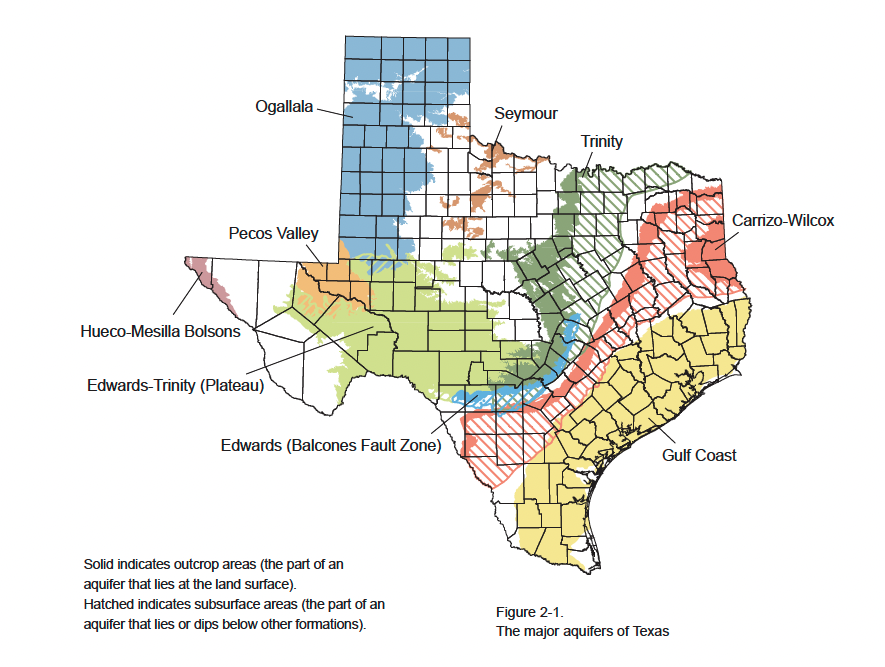
Texas sits atop nine major aquifers and 22 minor ones. The most famous include the Ogallala Aquifer (spanning the Texas Panhandle and extending across eight states), the Edwards Aquifer (the primary water source for San Antonio and surrounding Hill Country), and the Trinity Aquifer (serving the Dallas-Fort Worth metroplex).
These underground reservoirs aren’t infinite. Some, like the Ogallala, recharge so slowly that we’re essentially mining a non-renewable resource. Others, like portions of the Edwards, can recover relatively quickly—if we let them.
The Rule of Capture: A 120-Year-Old Legal Doctrine
In 1904, a Texas court established what would become one of the most consequential water laws in the state’s history. The case, Houston & T.C. Railway Co. v. East, introduced the “Rule of Capture” to Texas groundwater law. The principle is startlingly simple: if you own land in Texas, you can pump as much water from beneath it as you want—even if doing so drains your neighbor’s well dry.
The reasoning at the time made sense to early 20th-century judges. Groundwater was mysterious, its underground movements invisible and unpredictable. How could courts determine where underground water came from or who had rights to it? The solution was to let landowners capture whatever they could reach.
“Because the existence, origin, movement, and course of such waters, and the causes which govern and direct their movements, are so secret, occult, and concealed that an attempt to administer any set of legal rules in respect to them would be involved in hopeless uncertainty.”
— Texas Supreme Court, Houston & T.C. Railway Co. v. East (1904)
For over a century, this doctrine has governed how Texans use groundwater. The Texas Supreme Court reaffirmed the Rule of Capture as recently as 2016 in the landmark Edwards Aquifer Authority v. Day case, ruling that landowners have a constitutionally protected property interest in groundwater beneath their land.
But here’s where it gets complicated: having a right to the water doesn’t mean there’s always water to capture. And your neighbor’s pumping decisions directly affect how much water remains for you.
The Competing Interests: Who’s Fighting for Texas Groundwater?
The battle for aquifer access isn’t a simple story of good versus evil. It’s a collision of legitimate needs.
Agriculture: The Original Users
Farmers and ranchers have pumped Texas aquifers for generations, especially in the Panhandle region where irrigation transformed arid land into productive farms. Agricultural irrigation accounts for approximately 56% of all Texas groundwater use. Multi-generational ranching families have watched their wells decline as surrounding operations compete for the same resource.
Growing Cities: The Thirsty Newcomers
Texas cities are booming. The population is projected to nearly double by 2070, and municipalities are scrambling for water sources. San Antonio relies almost entirely on the Edwards Aquifer. Dallas-Fort Worth taps the Trinity. When cities buy up rural land specifically for water rights, it changes the landscape—and the politics—of groundwater access.
Industry: New Demands, Old Aquifers
Data centers now dot the Texas landscape, each requiring massive water supplies for cooling. Oil and gas operations use groundwater for hydraulic fracturing. Export terminals pump water for various industrial processes. These newer users bring economic growth—and increased competition for finite resources.
Ecosystems: The Silent Stakeholder
Springs, rivers, and wetlands depend on groundwater flows. When aquifer levels drop, springs stop flowing, threatening endangered species and unique ecosystems like those found around the Edwards Aquifer. Texas has seen several springs go permanently dry over the past century—including some that sustained Native American communities for thousands of years.
Groundwater Conservation Districts: A Partial Solution
Texas lawmakers recognized that pure Rule of Capture couldn’t last forever. Starting in the 1950s, the state began authorizing Groundwater Conservation Districts (GCDs)—local entities with power to regulate pumping, issue permits, and set production limits. Today, more than 100 GCDs cover roughly 70% of Texas land and 95% of the state’s groundwater production.
How Districts Work
GCDs operate differently across the state, but most require permits for high-volume wells and set limits on how much water can be pumped annually. The Edwards Aquifer Authority, for example, caps total pumping at 572,000 acre-feet per year and requires permits for any well capable of producing more than 25,000 gallons per day.
Despite these regulations, the fundamental Rule of Capture remains. GCDs can limit how much you pump, but they can’t eliminate the competitive dynamic—if you don’t use your allocation, someone else might.
The Limitations
GCDs face real constraints. They’re locally controlled, meaning they often favor established users. Their boundaries don’t always match aquifer boundaries, creating coordination challenges. And their funding depends on permit fees, creating potential conflicts of interest. Some critics argue they merely slow the depletion rather than creating truly sustainable management.
Still, districts have achieved measurable success in some areas. The Edwards Aquifer Authority helped prevent catastrophic spring flow decline during droughts, protecting endangered species habitat and maintaining San Antonio’s primary water supply.
What This Means for You: Understanding Your Water Future
If you’re a Texas property owner, farmer, or just someone who turns on the tap each morning, the aquifer story affects you directly. Here’s what matters:
- Property values increasingly depend on water access. In rural areas especially, the reliability of well water can significantly impact land values. Before buying property, investigate the local aquifer conditions and any GCD regulations.
- Municipal water rates reflect scarcity. As cities compete harder for water supplies, costs rise. Understanding where your city’s water comes from helps you anticipate future rate changes.
- Conservation pays off. Every gallon saved reduces pressure on shared aquifer resources. Texas offers various incentives for water-efficient appliances and landscaping.
The invisible war beneath Texas won’t be settled soon. The competing interests are too entrenched, the resource too valuable, and the legal framework too established for quick resolution. But understanding the dynamics helps you make better decisions—whether you’re choosing where to live, how to invest, or simply how to use water responsibly.
Texas aquifers sustained indigenous peoples for millennia and built the modern Texas economy. Whether they’ll sustain future generations depends largely on decisions being made right now—in courtrooms, district board meetings, and individual households across the state.
Need help navigating your water utility options? 2TurnItOn helps Texans understand and manage their utility services—including water.
Explore Water ServicesFrequently Asked Questions About Texas Aquifers
Can my neighbor legally pump my well dry in Texas?
Under the Rule of Capture, yes—technically. Texas law allows landowners to pump groundwater beneath their property even if it affects neighboring wells. However, if your area is covered by a Groundwater Conservation District, there may be permit limits that restrict how much any single user can pump.
How do I find out if my property is in a Groundwater Conservation District?
The Texas Water Development Board maintains a map of all GCDs. You can search by county or address on their website. If your property falls within a district, contact them directly to understand local rules about well permits and pumping limits.
Which Texas aquifer is most at risk of depletion?
The Ogallala Aquifer, which underlies the Texas Panhandle, faces the most significant long-term depletion challenges. In some areas, water levels have dropped more than 150 feet since irrigation began. The aquifer recharges very slowly—less than one inch per year in most places—making current pumping rates unsustainable.
Do I need a permit to drill a well on my Texas property?
It depends on your location. Outside GCD boundaries, most domestic and livestock wells don’t require permits. Within GCD boundaries, rules vary—some require permits for any new well, while others exempt small domestic wells. Always check with your local GCD or county before drilling.
How does climate change affect Texas aquifers?
Climate change impacts aquifers in multiple ways: reduced rainfall means less recharge, higher temperatures increase evaporation and water demand, and more intense droughts accelerate pumping. The Texas Water Development Board projects that aquifer supplies could decline by 30% by 2070 under current trends.
Sources & Further Reading
- Texas Water Development Board. (2022). 2022 State Water Plan: Water for Texas. twdb.texas.gov
- Texas Supreme Court. (2016). Edwards Aquifer Authority v. Day, 369 S.W.3d 814. Landmark ruling affirming landowner property rights in groundwater.
- Texas Water Development Board. (2020). Groundwater Database Reports. Data on aquifer levels, production, and recharge rates across Texas aquifers.
- Edwards Aquifer Authority. (2024). Aquifer Management and Regulations. edwardsaquifer.org
- Texas Alliance of Groundwater Districts. Understanding Groundwater Conservation Districts. Overview of GCD formation, authority, and operations in Texas.